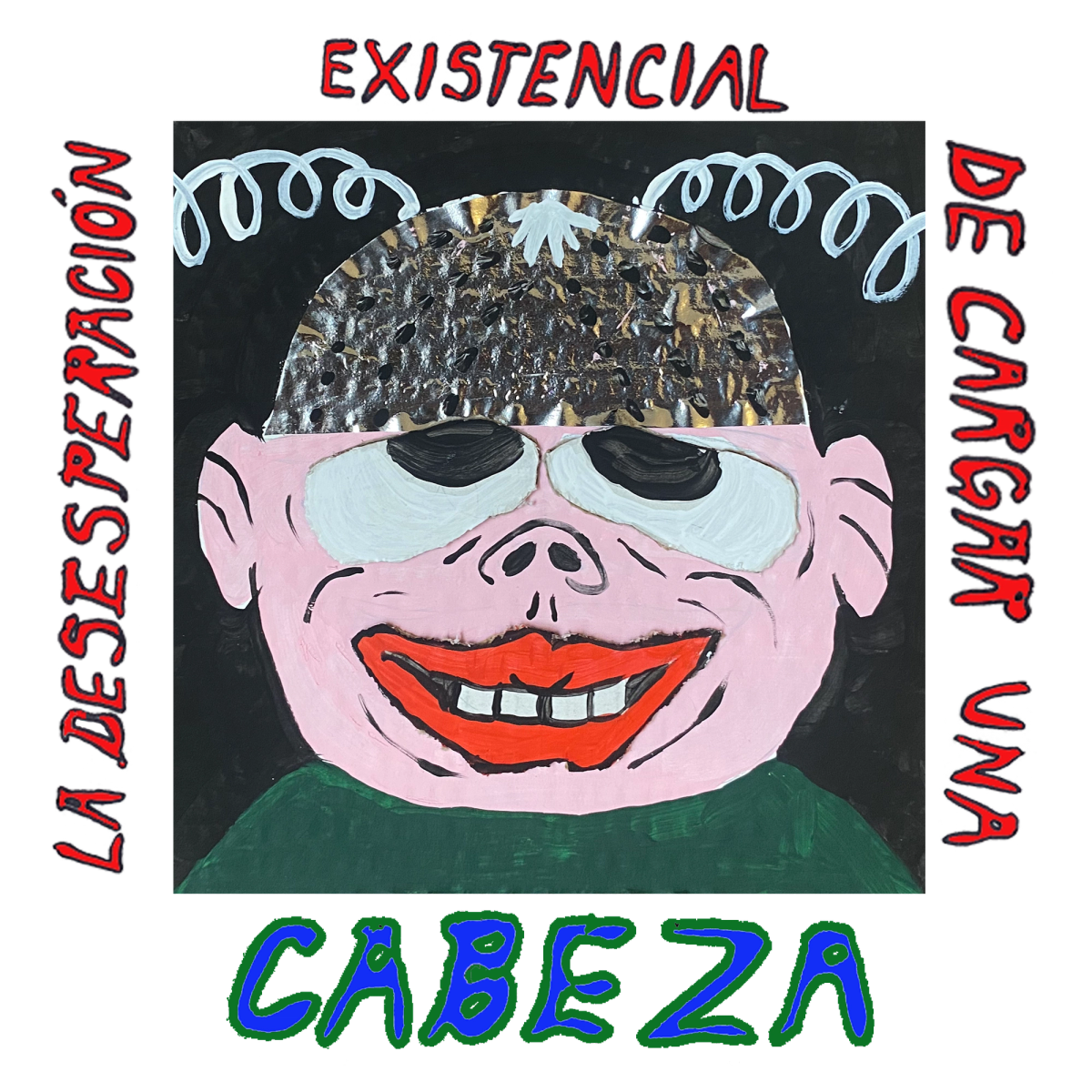
Exhibition: The Existential Despair of Bearing a Head
Artist: Carolina Berrocal
Curatorship: Roselin Rodríguez Espinosa
At various moments in history, humanity has fantasized about not having a head. Acéphale was the name of the French journal and secret society led by Georges Bataille in 1936, whose monstrous icon was drawn by André Masson. Its pages speculated, in an antifascist spirit, on how to rid oneself of the martyrdom of thinking and the delusions of reason. In Bataille’s words, “man has escaped his head like a condemned man escaping from prison.”
This is understandable in many dimensions, because bearing its weight — literally and metaphorically — is overwhelming and maddening from birth. In the first months of life, one of the greatest challenges for a human being is to gather all their strength to hold up their head and achieve what they call “the vital curve” with the back of the body. The process is arduous and frustrating. Metaphorically speaking, the surrender is also total: bearing the weight of a thought can cost a life. Ideas can be fleeting revelations forgotten in an instant, or carry the devastating capacity to build and destroy worlds. There, too, is where the creative process of art begins.
Carolina Berrocal (Mexico City, 1993) presents a sequence of images that capture the trying moment of an idea being born. The narrative reflects the anguish that arises within the mind during the act of thinking, because the flow of consciousness collides with the mind’s limits, just as the body confronts the limits of its outer environment to achieve its realization. The character who cannot stop thinking becomes overwhelmed, containing inner micro-explosions with every paradox encountered and every spark of desire that finds no form. The self multiplies searching for exits in a hall of mirrors and electrifies itself to the incandescence of an idea. It then arrives at the intuition that the limits of space are the limits of its imagination. But by then it is already exhausted and only wants to rest with a firmament of stars in its eyes.
The pieces are made from cardboard cutouts, colored papers, and acrylic paint, following a materiality of educational crafts that recalls the pedagogical vocation of the fable. The story told can reflect many of the lived experiences of the creative process in a world that demands overproductivity under conditions of information saturation and exploitation. It would not be hard to imagine it as an experience recounted in the workshop that Carolina Berrocal herself has run for several years, called Neuróticos artísticos (Artistic Neurotics). It is “a pedagogical project that needs to sow suspicion around the professionalization of art while also creating a space of mutual aid where listening, venting, catharsis, critique, and reflection can address the various challenges of contemporary artistic labor.” In this way, the series joins the editions for the altarpiece in the lobby of El Castillo de Chapultepec with a meta-artistic vision that plants the idea that we are a community sharing the existential despair of bearing a head.
Roselin Rodríguez Espinosa